Moving is math disguised as heavy lifting. We built the SmartStow Moving Calculator to replace the anxiety of guessing with the certainty of data.
Most people underestimate their move by nearly 50%. You stare at a closet and think "five boxes," but three hours later you've filled ten and you're out of tape. We created a free tool to fix this estimation gap, giving you a precise forecast of the boxes, time, and truck size you actually need.
Get Your Moving Estimate Now
Don't guess. Use the calculator to get your customized supply list and time budget.
Open Calculator →Free tool • No email required
How to Use the Calculator (The "Honest" Way)
Calculators are only as good as the data you feed them. To get an estimate that actually holds up on moving day, you need to navigate the tool correctly. Here is your step-by-step guide.
Step 1: Inventory Density ("Stuff Level")
This is where most people lie to themselves. We included a "Stuff Level" selector because a "3-Bedroom Home" isn't a standard unit of measurement. A minimalist apartment and a collector's house might have the same floor plan, but they have drastically different volumes.
- Minimalist: Choose this only if your closets have empty space.
- Average: The default. Includes the junk drawer, the "maybe I'll wear this" clothes, and the standard kitchen gadgets.
- Collector: Be honest. If you have a garage full of gear, a library of books, or shelves of collectibles, select this. It applies a 1.6x multiplier to your base volume.
Step 2: The Hobby Matrix
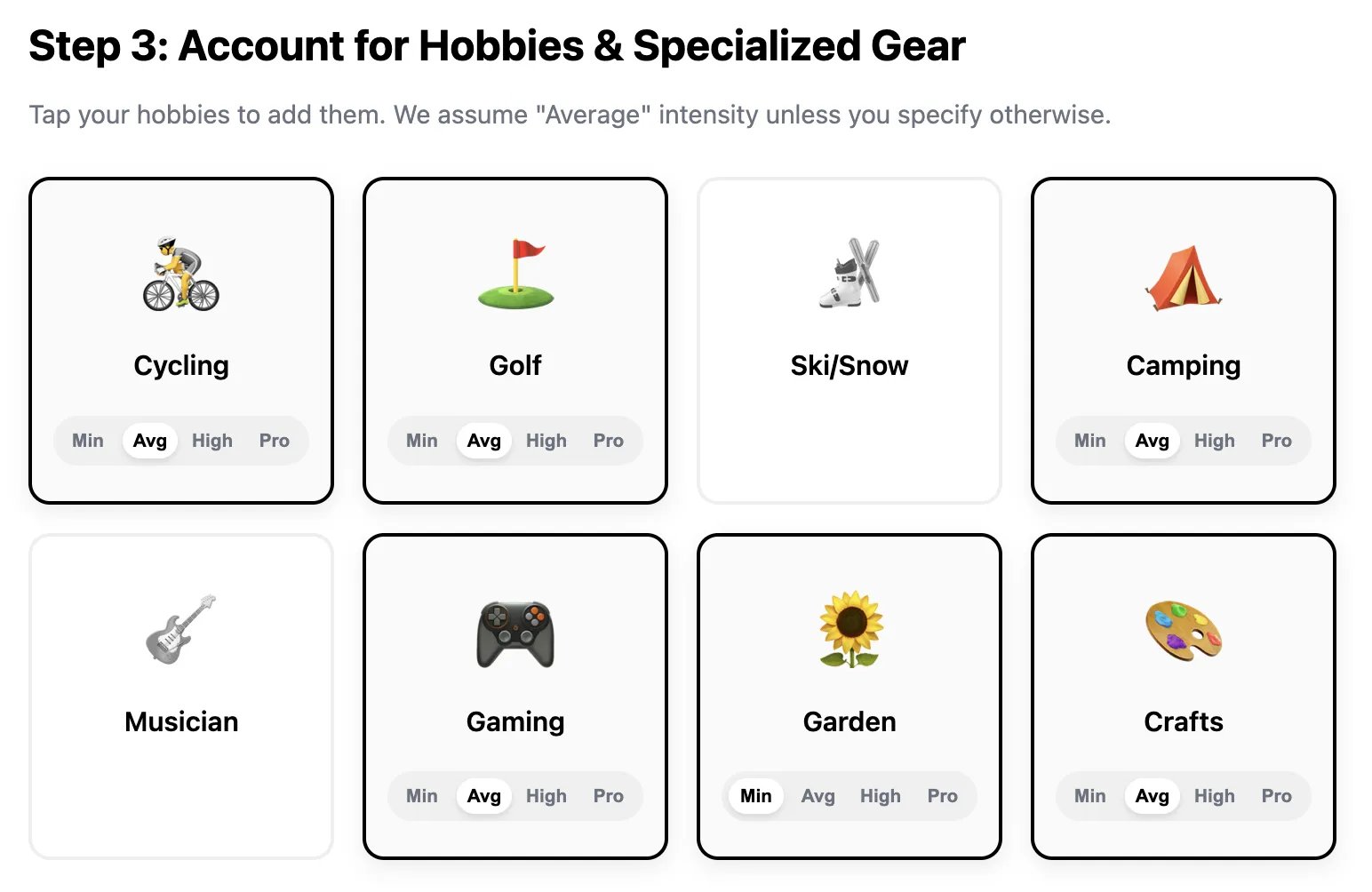
Standard calculators ignore your lifestyle. We don't. A cyclist needs way more truck space than a gamer.
Tap the icons to add your hobbies. Crucially, adjust the Intensity Level. A "Weekend Camper" (Avg) might need 25 cubic feet of space, but a "Pro Camper" with a roof tent and winter gear needs 100 cubic feet. Don't skip this section—it's often where the "overflow" items come from.
Step 3: Furniture & Large Items
We've pre-filled this based on your home size, but every home is unique. If you've sold your sectional or you're dumping your mattress, zero those out. The calculator updates your truck recommendation in real-time based on these volume changes.
The Calculator Counts the Boxes. SmartStow Tracks What's Inside.
Knowing you need 70 boxes is step one. Knowing which box has your coffee maker is step two. Use SmartStow to voice-log your items as you pack.
Start Free Trial →30-day free trial • No credit card required
Why We Built This: The Technical "Why"
We didn't just build this calculator because "moving is hard." We built it because we saw a flaw in how moving is traditionally planned.
Most estimates are linear: 1 Room = 20 Boxes. But reality is logarithmic. Complexity compounds.
The Technical Choice: Range-Based Logic
You'll notice our calculator doesn't give you a single, false number. It gives you a Range (e.g., "15 - 20 hours").
In the code, we implemented variables for EFFICIENCY_MIN (0.75) and EFFICIENCY_MAX (0.65). This accounts for the "Tetris Factor." A professional mover packs a truck with high efficiency. You, tired at 2 AM, will pack with low efficiency. Our tool calculates the upper bound to ensure you rent a truck big enough for an imperfect pack.
Volumetric Weight by Hobby
We realized that "hobbies" are the silent killers of moving plans. A guitar isn't just a guitar; it's a case, an amp, a pedalboard, and stands. In our backend logic, we assigned specific volumetric profiles to these activities. For example, selecting "Cycling (Pro)" adds volume equivalent to 10 extra medium boxes plus furniture space.
Frequently Asked Questions
Why does it recommend a 26' truck for my 3-bedroom house?
It sounds big, but a 3-bedroom home usually fills roughly 1,000 to 1,300 cubic feet. A 20' truck often caps out around 1,000 cubic feet. If you are on the "Collector" end of the spectrum, squeezing into a 20' truck creates a high risk of needing a second trip. Our algorithm prioritizes safety over optimization—we'd rather you have 2 feet of empty space than leave your mattress on the curb.
How accurate is the "Packing Time" estimate?
We base our packing speed on a benchmark of 3 to 5 boxes per hour. This assumes you are wrapping dishes, taping boxes, and labeling. If you are just throwing clothes into garbage bags (not recommended!), you will be faster. But for a safe pack, the estimate is usually frighteningly accurate.
The "Manual Labeling" time seems high. Is it real?
Yes. We conducted a timed study comparing writing labels vs. voice-logging. Writing "Kitchen - Pots, Pans, Spatula" on a box takes about twice as long as speaking it into SmartStow. Over 100 boxes, those seconds add up to hours. You can read the full breakdown of that experiment here.
The Final Step
This calculator gives you the map. Now you need to drive the car.
Don't let the packing process overwhelm you. Get your box count, rent the right truck, and then download SmartStow to ensure that every single item you pack is searchable, findable, and safe.
Plan Your Move. Track Your Life.
You have your estimate. Now get the tool that makes packing 2x faster.
✓ 30-day free trial ✓ No credit card required ✓ Voice-first inventory